

10 Ipon Challenge Mistakes You're Probably Making Right Now
Thu, 09/24/2026 | Edited by Therese Sta. Maria
If your ipon challenge has died a quiet death every January since 2019, you are not alone — and it's probably not a willpower problem. Most ipon challenge mistakes aren't about motivation at all. They're about where the money sits, how the challenge is structured, and what happens the moment life gets messy. Fix the structure, and the discipline part gets a whole lot easier. Here are the 10 most common ways an ipon challenge Philippines attempt quietly falls apart — and how to actually make it to week 52 with something to show for it. If you've searched "ipon challenge Philippines" looking for the version that actually works, this is that list.
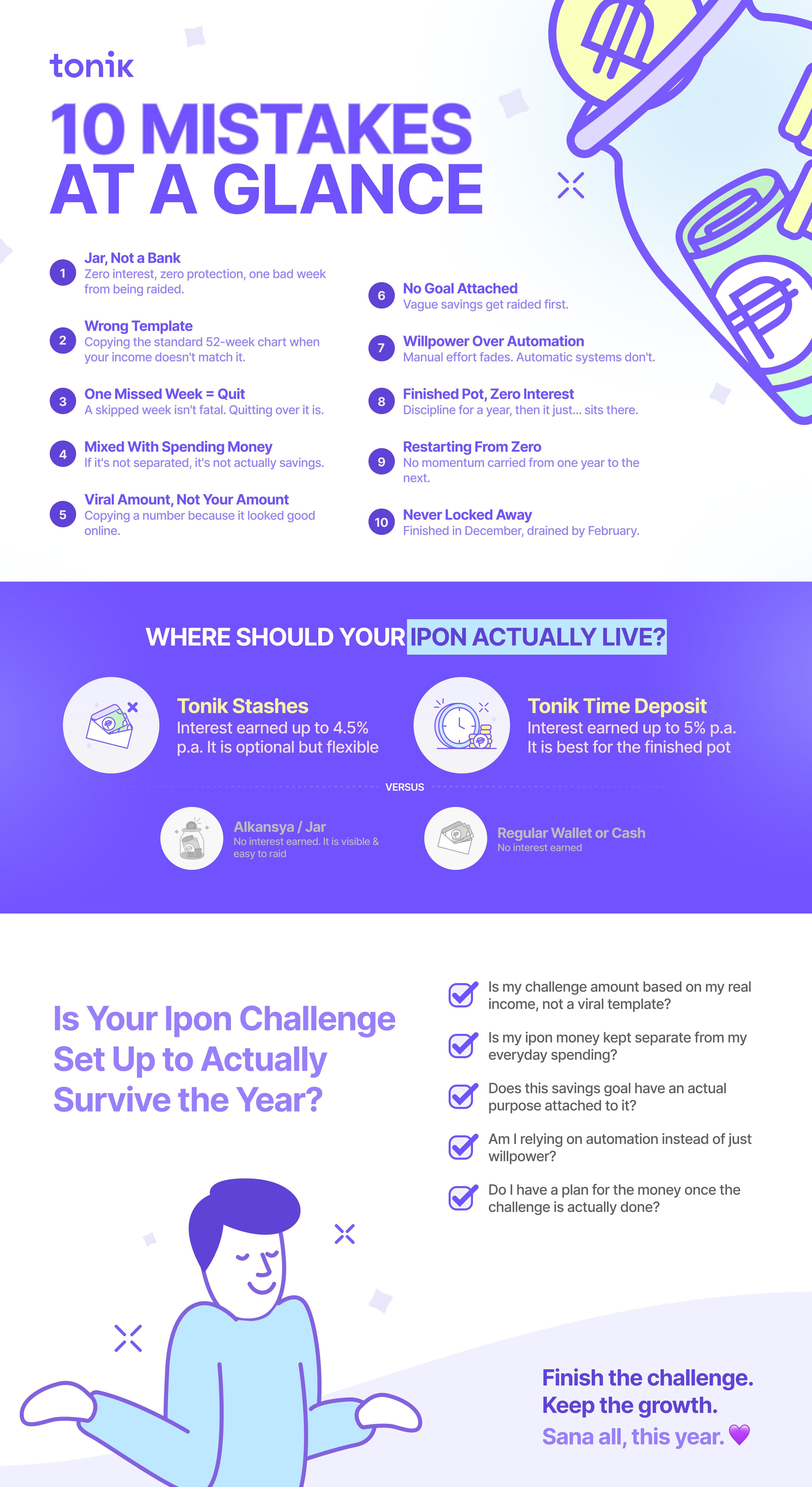
The alkansya is iconic, we get it — there's something satisfying about watching coins pile up in a jar on top of the fridge. But it's also one of the most common ipon challenge mistakes out there, because a jar earns you exactly ₱0 in interest no matter how long your money sits in it. Worse, it's sitting in plain sight, which means it's one bad week away from becoming your emergency Shopee fund. A jar has no protection, no growth, and no accountability besides your own memory. If the money you're setting aside is meant to actually grow, it needs to be somewhere that pays you for waiting — not just somewhere that holds your coins hostage until Christmas.
The classic 52-week ipon challenge template looks harmless in week one — ₱20, ₱40, ₱60 — until you hit week 50 and suddenly you're expected to drop ₱2,600 in a single week. For anyone on an irregular income, a minimum-wage job, or freelance pay that swings month to month, that back-half spike is exactly where the whole thing collapses. This is one of the sneakier ipon challenge mistakes, because it doesn't feel like a mistake at first — it feels like discipline, right up until it becomes mathematically impossible. The fix isn't to try harder; it's to flip the schedule, scale the amounts to your actual paycheck, or use a monthly version built around your real income instead of a generic template someone else designed.
Life happens — a flat tire, a hospital run, a niece's christening you didn't budget for — and suddenly you've missed a week. For most people, that's the exact moment the whole challenge quietly dies, not because the missed week itself was fatal, but because "I already failed" feels like permission to stop entirely. This is peak ipon challenge mistakes territory: perfectionism disguised as discipline. The actual fix is almost insultingly simple — just catch up by doubling the next week's amount, or shift the missed week to the very end. One skipped week was never the problem. Quitting over it is.
If your challenge savings live in the same account — or worse, the same wallet — as your grocery money and your Grab budget, you don't actually have savings. You have a number that occasionally gets smaller when temptation wins, which, let's be honest, is often. This is where a tool like Tonik's Stashes earns its keep: it lets you set aside money for a specific goal, completely separate from your everyday spending, while it still quietly earns interest sitting there. Out of sight, out of impulse-buy range, and actually growing instead of just existing.
Somebody's TikTok about their ₱100,000 ipon challenge hits different at 11 PM, and suddenly you're committing to a savings goal that has nothing to do with your actual paycheck. Aspirational, sure. Sustainable? Rarely. Copying a challenge amount because it looked impressive online, rather than because it fits your income, is one of the most avoidable ipon challenge mistakes on this entire list — you're setting yourself up to fail before week one even starts. Pick the version that fits your life, not the version that'll get the most likes if you post about it.
"Just because" is a weak reason to keep going once things get inconvenient — and things always get inconvenient by week 30. Ipon challenges that survive the whole year almost always have a specific goal attached to them: a plane ticket, an emergency fund, a laptop, a wedding, something with a face and a date. Vague savings get raided first because there's no clear reason not to. This is exactly what Tonik's Stashes are built for — you can set money aside toward a specific goal instead of one big undefined pile, which makes it a lot harder to justify dipping into "just this once."
Manually moving money every single week, on purpose, using nothing but self-discipline, is a genuinely hard way to run a 52-week commitment — and it's one of the quieter ipon challenge mistakes because it looks responsible right up until week 20, when motivation naturally dips. The people who actually finish these challenges tend to remove themselves from the equation as much as possible: automatic transfers, standing reminders, or a savings pocket that isn't sitting in the same place as their spending money, tempting them every payday. Willpower is unreliable. A system that doesn't need willpower isn't.
Say you actually make it. Fifty-two weeks, discipline intact, ₱60,000 or more sitting in your account. Congratulations — now what? A huge number of people finish the challenge and then just... leave the money where it is, in a regular account earning close to nothing, for months. That's real opportunity cost quietly disappearing. This is where a Tonik Time Deposit comes in: lock in that lump sum for a fixed term at a rate up to 5% p.a., instead of letting a year of discipline sit around earning close to nothing while it waits for you to decide what to do with it.
Plenty of Filipinos treat the ipon challenge as a one-year event — finish in December, spend it all by February, restart from ₱20 the following January like the previous year never happened. That reset-to-zero pattern is one of the more demoralizing ipon challenge mistakes, because it means you never actually build momentum year over year. The version that works better treats each completed challenge as a stacking block: roll last year's finished pot into a longer-term goal, then start a fresh challenge on top of it, instead of spending down to zero and starting the climb all over again.
The final, most heartbreaking entry on this list: finishing the entire challenge, then draining the pot two weeks later on a "you deserve this" splurge, because the money was still sitting somewhere easy to reach. A full year of ₱20-a-week discipline can disappear in one Shopee sale if there's nothing stopping the withdrawal. Parking the finished amount somewhere with a bit of friction — a locked-term Time Deposit, or a clearly labeled Stash you've mentally filed as untouchable — makes it meaningfully harder to undo twelve months of work over a weekend impulse.
None of these ipon challenge mistakes are about being bad with money — they're structural problems that quietly derail even genuinely disciplined people. Fix where the money sits, attach a real goal to it, and remove as much willpower from the equation as you can, and an ipon challenge Philippines attempt stops being a January resolution that dies by March.
Tonik's Stashes let you set aside money for a specific goal, separate from your everyday spending, while it earns interest up to 4.5% p.a. And once your challenge is done, a Tonik Time Deposit lets you lock in that finished pot at a rate up to 5% p.a. — so a year of discipline actually keeps growing instead of just sitting there.
Sana all finally finish that ipon challenge this year, Luv. Small weekly amounts, the right place to put them, and just a little bit of structure — that's really the whole formula. XOXO, Tonik 💜