

How to Save Money Every Day Without Being ‘Kuripot’ All the Time
Tue, 06/16/2026 | Edited by Therese Sta. Maria
Figuring out how to save money doesn't mean saying no to everything you enjoy. Here's how to cut daily expenses smartly — without the guilt, the burnout, or the sad desk lunch.
Let's be honest — when most people think about how to save money, they picture extreme sacrifices: skipping milk tea forever, eating the same meal on repeat, and feeling vaguely miserable about it. But here's the thing: that kind of saving rarely sticks. Real, sustainable saving is about being intentional with your money, not punishing yourself with it.
In reality, many financially successful people built wealth while managing mortgages, business loans, education loans, or other forms of debt.
The good news? Small, smart adjustments to your daily expenses can add up to serious savings — without making your life feel like a budgeting boot camp.
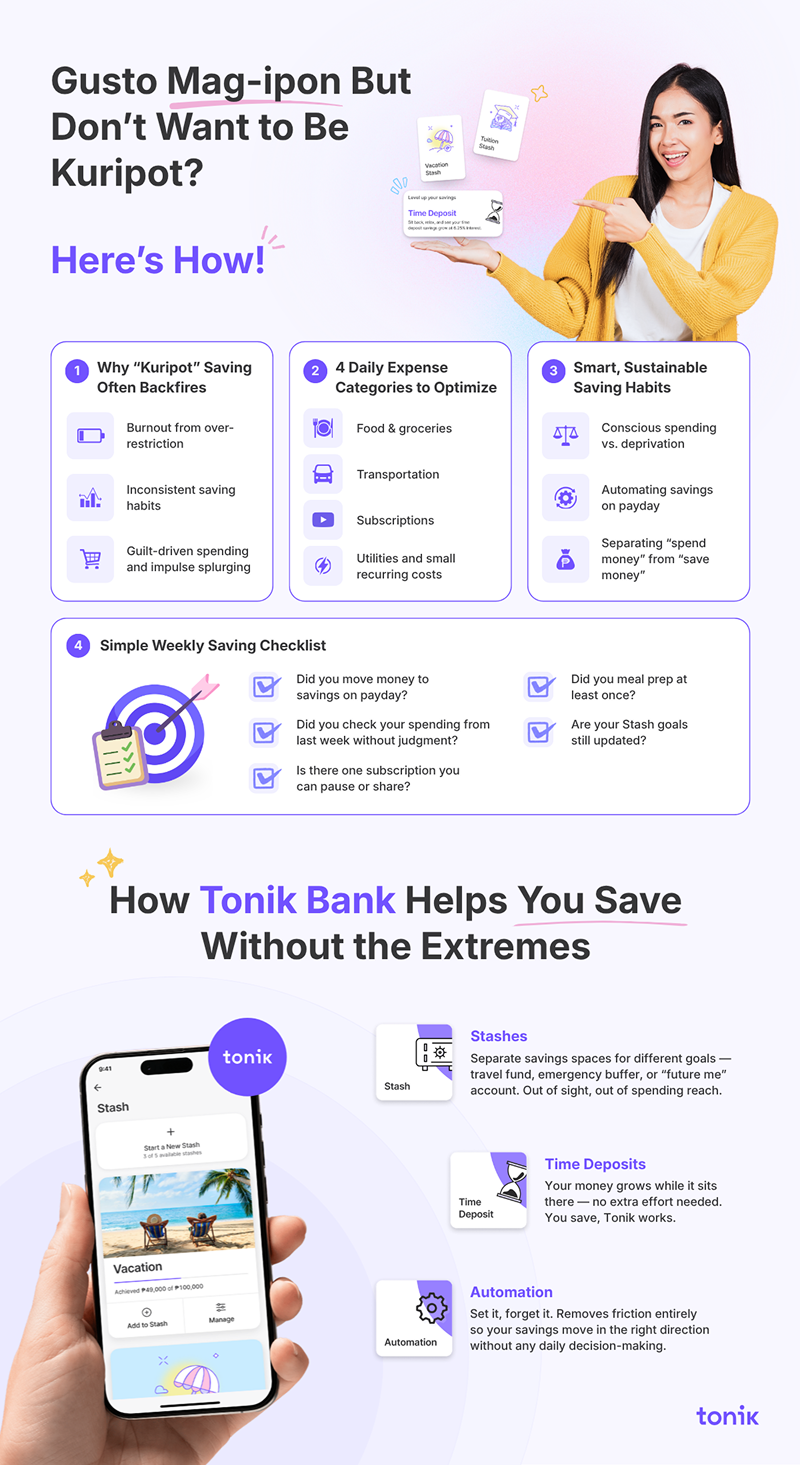
There's a reason the strictest budgeters often end up on a guilt-fueled shopping spree by month three. If you've ever tried to figure out how to save money by cutting everything at once, you've probably hit one of these walls.
Burnout hits fast when every purchase feels like a moral debate. If you're mentally calculating the cost of every cup of coffee, spending stops being a choice and starts feeling like a punishment — and that's not sustainable long-term.
Inconsistent habits are the natural result. You go hard for two weeks, break once, feel like you've failed, and abandon the whole plan. Sound familiar? That cycle isn't a willpower problem — it's a system problem.
Guilt-driven spending is the ironic plot twist. Deprivation tends to trigger overcorrection. Restrict too hard, and you're more likely to splurge impulsively just to feel normal again — which undoes every peso you saved.
The fix isn't saving less. It's saving smarter.
You don't have to overhaul your entire lifestyle to save money on daily expenses. Start with these four categories — they're where most of the leaks are.
Food & groceries — Meal prepping even two or three days a week can save a surprising amount. You don't have to cook everything from scratch; sometimes it's just buying snacks in bulk instead of from the convenience store, or having a default cheap-but-good lunch spot instead of deciding every day.
Transportation — If you commute, mapping out the most cost-efficient route (even if it means a short walk) adds up over weeks. Carpooling, bike-friendly routes, and knowing when to Grab vs. commute are worth figuring out once and automating mentally.
Subscriptions — Do a quick audit. How many streaming platforms are you actually using? A shared family plan, or rotating one service at a time, can cut this category in half without feeling like a loss.
Utilities and small recurring costs — Unplugging devices you're not using, turning off the aircon 30 minutes before you leave, switching to a prepaid data plan if your postpaid feels like overkill — these feel small but compound quickly.
The best saving money tips share one core idea: conscious spending is not the same as deprivation.
You get to decide what your money is for. Spend deliberately on what genuinely adds value to your life — and cut the stuff that doesn't. That's not sacrifice. That's just being the one in charge.
Automate your savings so the decision is made before you can talk yourself out of it. One of the most effective saving money tips out there is to move a fixed amount to savings on payday — not after you've already spent. What you don't see, you don't miss — and you don't spend.
Separate your "spend money" from your "save money." When everything lives in one account, the lines blur fast. Keeping them in distinct spaces makes it easier to spend freely on what's allocated and save consistently on what's set aside — no math required.
This is exactly where Tonik was built to help. Luv, learning how to save money shouldn't feel like a chore — and with the right tools, it genuinely doesn't. 💜
Stashes let you create separate savings spaces for different goals — whether that's a travel fund, emergency buffer, or just your "future me" account. Out of sight, out of spending reach. It's one of the easiest ways to save money without even thinking about it.
Time Deposits mean your money actually grows while it sits there — no extra effort required on your end. You save, Tonik works.
Automation removes the friction entirely. Set it, forget it, and watch your balance move in the right direction without having to think about it every single day.
Saving isn't about being perfect. It's about building a setup that works even on your laziest days.
☑ Did you move money to savings on payday?
☑ Did you check your spending from last week without judgment?
☑ Is there one subscription you can pause or share?
☑ Did you meal prep at least once?
☑ Are your Stash goals still updated?
Knowing how to save money on daily expenses doesn't require a dramatic lifestyle overhaul. It requires a smarter system.
Cut what doesn't matter to you. Keep what does. Automate the boring parts. And use tools — like Tonik — that make saving feel less like discipline and more like a default. Take it from Tonik’s very own CFO, and learn to be financially savvy like a pro!
Saving should support your life, not restrict it. The goal was never to have the most money at the cost of enjoying the life you're saving for. It was always to have enough — consistently, sustainably, and without the guilt. 💜